WITHOUT ENOUGH GIRLS-WHAT WILL LITTLE BOYS DO?
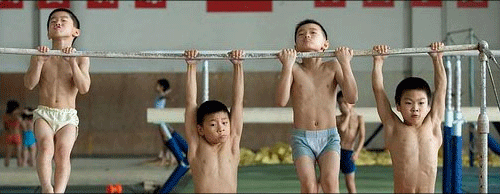
Olympic hopefuls today. Who will they be tomorrow if they face life without a wife?
In the developed world nature is usually allowed to run its course and the genders are in balance almost 100 percent of the time. At birth, the average is 106 little boys are born for every 100 girls. Around age 30, women pull even, and then begin to pull away. By age 75, there are almost twice as many women as men.
In parts of the developing world, the story is different. China has become one of the few countries where men outnumber women, and in India the results are much the same. One of the causes is abortion based on gender. When "Sex Selective Abortion" is practiced long enough and with enough scale it can upset the natural order of a population in ways never before contemplated. When the deck is intentionally stacked in favor of boys what will these "little boys" do when they discover there aren't enough girls to go around? How will society respond to what may be an entirely new definition of just letting "boys be boys?"
40,000,000 CHINESE BOYS ARE FACING LIFE WITHOUT A WIFE

Amazing adoption isn't an option more often
The Chinese Academy of Social Sciences predicts in the year 2020, China will have as many as 40,000,000 more young men than women under the age of 20. That's roughly the equivalent of the entire population of young men in the United States - or twice as many as in the three largest countries in Europe, all facing the prospect of being excluded from a society where having a family is a requirement just to "belong."
In 1978, China addressed its massive overpopulation problem by instituting a "one-child policy," which limited couples to just one offspring. By addressing its overpopulation problem in this way, as many as 400,000,000 abortions took place. China ended its one child policy in 2015, but serious damage was already done. In a culture where boys are the preferred sex, it's not surprising that the majority of these abortions were little girls. In some parts of China today, the ratio of boys to girls can be as high as 130-100. It’s doubtful the Chinese Government had any of this in mind when it addressed its overpopulation problem by instituting the one-child policy, but the impact certainly speaks for itself.
Complicating matters further, forced abortion traumatizes women and by some WHO estimates, as many as 500 Chinese women were committing suicide every day, mostly in the rural provinces. Today the female suicide rate is lower, but in a society where girls are devalued, it's no surprise that China still has one of the highest female suicide rate in the world.
It's somewhat unfair to speculate about what might happen when little boys become big boys with too much time on their hands, but most of the behavior is obvious and is already taking place. Human trafficking and sexual slavery are on the rise in China, but that's just the beginning. The evidence is equally clear there is increased violence almost everywhere an imbalance between the sexes, on this scale, has been allowed to occur. This violence appears to be localized at the moment, but how long will it last?
INDIA HAS LOST 50,000,000 BRIDES:
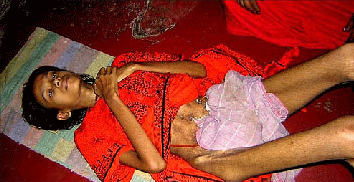
Dowry victim Roopa
Selective sex abortion is illegal in India, but they have neglected enforcing the law for far too long. Now their obsession with little boys has created an imbalance between the sexes that has led to other social consequences. In some areas, the boys already outnumber the girls by as much as two to one. And while the Indian people are known as being naturally warm and kind, who knows what changes might take place in their behavior as a result of having too many young men without brides to nurture them and occupy at least some of their time. Female suicide rates among young women in India are similar to China and these two countries combined account for roughly 50 percent of female suicides for the entire world.
In some respects, the Indian culture is even more obsessed with little boy babies than the Chinese. While they didn't impose a "one-child" law on their people, the advent of ultrasound in the 1980's made the sex of the baby easy to determine. As a result, female babies began to disappear in record numbers, even after they were born. Today the preferred method is abortion. A few years ago one survey of Indian abortion clinics found that as many as 7,999 out of 8,000 aborted babies were little girls. One of the most inexplicable aspects of the problem in India is that "Sex Selective Abortion" takes place more often in the north, where the people are more highly educated and far more prosperous.

Indian bride on her wedding day
It's hard to understand why a poor, overpopulated country where so many families can't afford too many children isn't more sensitive to their female selection problem. In the poorer parts of the country, where ultrasound technology may not be available, when the first born is a girl, if the second born is also a girl, the odds of it surviving to the age of five are staggeringly low.
The Indian tradition of the family of the bride providing a dowry, along with their daughter's hand in marriage, adds to the problem. If the dowry isn't large enough, the new bride's life can be in danger, or, at a minimum, she can be forced to suffer for the rest of her life for the insult caused by her family's lack of generosity. "Dowry deaths" are a serious problem in some parts of India, but the practice has other social consequences as well. Some families consider the birth of a girl as a future economic burden, leading many to conclude it is better to eliminate the problem now rather than later.
A LIGHT AT THE END OF A VERY DARK TUNNEL
People can draw attention to the problem, but only governments can make a problem as serious as Gendercide go away. India has a law on the books, but the country needs to summon the courage to enforce it. We understand that process is underway. India's large social groups are speaking out more forcefully on the subject as well and many have taken oaths to never engage in this practice again. Interestingly, more than half of India's popular soap operas now address some aspect of this complex issue every week. We are cautiously optimistic about the future.
India and China should be commended for being so forthcoming in releasing this sensitive information. Rather than condemn them, at this point in the process we might want focus our energy on encouraging them to continue their efforts to end it. One reason to consider some positive reinforcement for this new openness is they aren't alone. Centered primarily in Asia other countries with serious male population imbalances are Armenia, Azerbaijan, Georgia, Serbia and Belarus to name a few. According to the UN South Korea had a very serious problem at one time, but is now well on their way to having it under control. So, it can be done! Tom LeDuc